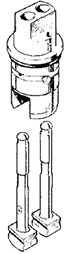
With this simple tool you can test how much air leaks along the cylinder of your M20 (or any other classic or modern bike) and the valves. It is NOT a compression tester; that one will give only an impression how high your compression is, but not why it is low!
First of all, you need a compressor capable of giving at least 6 Bar or 100 PSI pressure, a pressure regulator, a pressure gage, a valve and some other small things the well-seasoned DIY guy has in his "Misc."-box, or can make from readily available parts in hardware stores.
The pressure gage on the compressor should be set to a slightly higher value than the maximum value on the tester, which in turn should preferably be set to a round figure, such as 5 Bar or 80 PSI. This 5 Bar or 80 PSI will be the 100% leak-free value.
Now, from the compressor onwards, you have the pressure regulator (usually furnished complete with a pressure gage), the valve, a piece of flexible hose, and an adapter made from a discarded spark plug. For obvious reasons it is important to make this adapter in two parts: the part that screws in the cylinder head, and the part that is fixed to the hose. The pictures give an idea how I did this; I am not sure if the garden hose connection I used is available outside the Netherlands, so you will have to improvise!
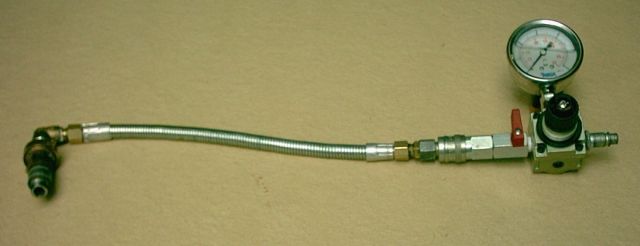
It is important that after the valve there is somewhere a damper (constriction) in the hose, with a small hole ( 1 - 1.5 mm), so that the air pressure cannot build up too quickly.
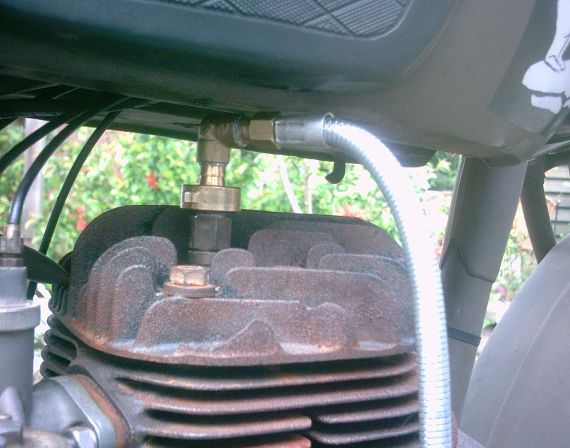
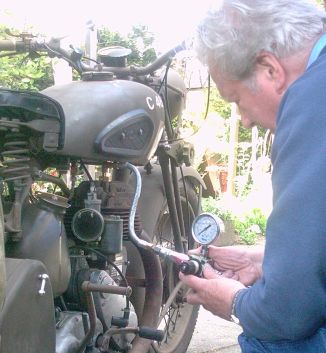
If the pressure goes down to 96 - 98%: congratulations! You have a motor fit for another 60 years of service. But below 92% something has to be done.
I had a problem in that I could not sufficiently prevent the piston from moving; this resulted in slowly opening the exhaust valve. I solved this by temporarily removing the exhaust timing gear. But don't forget to replace it in its correct position: point on point and dash on dash as in figure below.
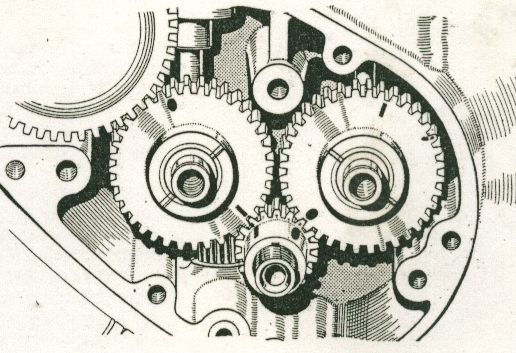
If you find bad results with a cold engine, try also after warming it up; usually, results will be better. And a further test consists of allowing the piston to go down slowly, backwards from compression full compression stroke; this may give an indication about local wear of the cylinder.